
5 Powerful Electric Forklift Upgrades That Cut Operating Costs
Although Forklift Upgrades may not sound headline worthy, they can help reduce losses within your warehouse. Carefully chosen improvements can significantly improve performance, and quicker ROI than many managers would expect through smart Forklift Upgrades.
Improve performance with these strategic Forklift Upgrades:
Table of Contents
1. Speedy Mast Movement
Old electric forklifts had very slow mast movement, making Forklift Upgrades essential for modern hubs.
With new equipment such as the Yale ERC-VG2 series, mast movement is approximately 65% faster than the closest competitors. On an active receiving area, these types of Forklift Upgrades help clear lanes extremely quickly. This allows the next pallet to be handled quickly, reducing bottlenecks in receiving.
As the mast speed has improved via modern Forklift Upgrades, the forks can be moved in and out extremely quickly. Whether the forklift is lightly or heavily loaded, the movement is smooth with no interruption to the driver. As a result, shift supervisors will see improvements. With predictable cycle times, scheduling becomes much easier.
As the mast can be lifted very quickly, fewer forklifts are required in peak times thanks to targeted Forklift Upgrades. This saves capital expenditure. Improvements such as this can give ROI within months.
2. Lithium Ion Batteries
With lead acid batteries, many problems can occur. Good ventilation must be in place. Regular battery swaps must be carried out, and spare batteries must be charged constantly. To add to this, one employee must be dedicated to pulling heavy batteries in and out without proper Forklift Upgrades.
Lithium Ion batteries and related Forklift Upgrades eliminate these issues entirely.
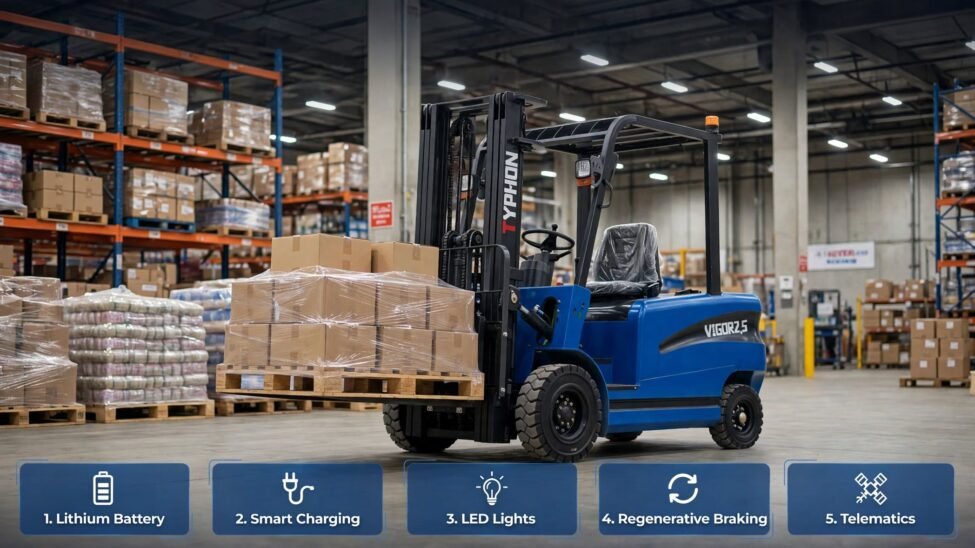
Opportunistic charging can be carried out. If the forklift is brought into charge during a break, it can be put back into service with almost fully charged batteries in 20 minutes. Most models from Clark with Fusion batteries can be fully charged in around 2 hours. Partial charging causes no issues. In facilities with multiple shifts, implementing these Forklift Upgrades means it is now enough to only have one integrated battery per forklift.
The battery charging room can be re-purposed. No more acid spillages, and no more dangerous goods documentation to handle.
Lithium ion batteries introduced via smart Forklift Upgrades have improved thermal properties compared to lead acid. This is a big advantage in many warehouses across Asia. Thermal issues are reduced meaning battery lifespan is increased. Therefore, there are fewer unexpected issues in the middle of a shift. Overall, Forklift Upgrades like this have a huge impact on shift performance.
3. Improved Visibility & Ergonomics
Looking through masts with chains, hoses and thick pillars can be confusing unless resolved with proper Forklift Upgrades.
By improving visibility in the through mast by 34%, Yale has made it much easier to handle pallets in high racking. Drivers can clearly see the beam and forks with greater ease. Pallets can be placed without the need for stretching, twisting or waiting for guidance. This results in very efficient handling driven by essential Forklift Upgrades.
Similar designs have been made by Jungheinrich in the EFG series. By increasing the foot well by approximately 10cm, reducing step in height, and using suspended seating with ergonomically placed controls, driver fatigue can be reduced. In the late afternoon, drivers can feel a lot of fatigue.
This can cause drivers to bump into racking. Replacing damaged racking is far more expensive than investing in these Forklift Upgrades like improved seating.
Improved seating also has a benefit on staff retention. Due to the physical nature of the work in a warehouse, forklifts that cause discomfort can cause experienced workers to leave. However, if forklifts feel like a proper tool to perform tasks, employees are more likely to stay. Replacing staff with new hires and training is far more expensive than simple structural Forklift Upgrades. Therefore, seating modifications and other Forklift Upgrades can quietly save you money.
4. Telematics
All warehouse managers know when something is seemingly ‘off’ with a forklift. Maybe it is going to the wrong aisle repeatedly, or getting into accidents in a specific corner. While this can be useful information, basic Forklift Upgrades like telematics tell you precisely which forklift is overworked, or sitting idle for 6 hours.
Telematics systems such as Yale Vision, Toyota I_Site and Linde FleetFOCUS can be very beneficial. Many modern models come standard with these advanced Forklift Upgrades.
While the actual dashboards are not particularly important, the information they provide is. Can we identify common accident locations, and therefore determine whether training is an issue, or if it’s due to an unobservable corner? A sudden reduction in battery life may indicate that the battery is starting to fail. Utilisation information (per forklift/shift/driver) means we can be sure our fleet is working efficiently according to demand.
Therefore, purchasing additional forklifts is no longer necessarily the best option when smart Forklift Upgrades are available.
A rarely mentioned benefit is that telematics eliminates arguments. If a supervisor claims forklift 4 is continually sitting idle, but the driver claims otherwise, the data can be used quickly to confirm who is correct. No arguments or assumptions can be made. Instead, facts can be seen on screen. Technical Forklift Upgrades like this can improve teamwork in a team.
5. Narrow Aisle Design
Efficient storage determines profitable performance in a warehouse. Having wider aisles means that more money is lost without layout Forklift Upgrades.
Electric forklifts (three wheel or compact counter-balance) have improved significantly so that tight turns can be made without instability. The Bobcat B16-20-NT range (with lithium ion battery and twin drive motors) allows for efficient operation in narrow aisles. This avoids three-point turns in narrow aisles, which can be time consuming and cause damage to rack.
The design of the forklift, and the instant smooth delivery of torque from an electric motor, allows for very controlled movement of a loaded forklift in tight areas. Regenerative braking, which comes standard on models such as the TCM FTB series, allows for further control on slopes. Simply removing pressure from the accelerator means that the forklift slows down in a predictable fashion. Energy is captured rather than causing wear on brake pads.
Having aisles only 3.2-3.5m wide can have a huge effect on a warehouse enabled by precise Forklift Upgrades.
If there are many more pallet positions possible in the same footprint, more money can be earned in less space. No new rental is required, nor new buildings. Simply a smarter layout enabled by Forklift Upgrades allows more pallets to be stored. Modifications such as this can have the largest hidden savings.
6. Conclusion
Forklift Upgrades do not stand alone.
Quick lifting speeds may be useless if the battery runs out half way through a shift. If drivers are rushing to finish tasks due to discomfort in the cab, the telematics dashboard may be useless.
However, within this new generation of equipment, Forklift Upgrades complement each other. Having lithium ion batteries to allow opportunistic charging means less space is taken up on the floor. The wider mast windows for precise placing reduces the number of impact incidents reported in telematics. And finally, having a compact design for narrow aisles requires very precise low speed control, which is natural in modern Forklift Upgrades.
Across Asia, many warehouses are considering implementing extensive Forklift Upgrades to their fleets. Power is no longer the main consideration, as diesel can be matched. Instead, the consideration should be on which combination of improvements would be best for their floor. Considering shift patterns, aisle widths, rack heights, charging windows and operator crew will allow the best decision to be made.
Different warehouses will have different answers based on their specific conditions, but the direction for Forklift Upgrades is now clear.
Our Business Partner